
Strategy Overview: The Logistics Litmus Test
Target Audience: Importers and B2B buyers trying to verify if their Chinese buggy supplier is a real factory or a disguised trading company.
Core Challenge: Middlemen steal factory photos and claim to be manufacturers. If you partner with them, you pay invisible markups and suffer from inefficient, high-cost shipping methods.
Keldi Solution: Use logistics engineering as the ultimate vetting tool. A true source factory possesses the metalworking capability to build custom 3D SKD steel frames. Middlemen do not.
Result / ROI: Buyers instantly identify fake factories, avoid the damage risks of wooden crates, and unlock maximum container density to dramatically lower their per-unit Landed Cost.
In the B2B electric vehicle trade, anyone can hire a designer to build a glossy website and claim they are a "massive source factory." They can copy technical specifications and steal product photos. But there is one thing a trading company cannot fake: heavy-duty logistics engineering.
If you want to know immediately whether you are talking to a genuine manufacturer or a broker sitting in a rented office, ask them for a detailed blueprint of their SKD (Semi-Knocked Down) container loading process.
If they offer you "plywood boxes" or vague promises, run. Here is exactly why trading companies cannot offer true 3D SKD steel packaging, and how this failure drains your profit margins.
Trading companies do not manufacture vehicles; they buy fully assembled carts from various small workshops and then resell them to you. Because they do not control the production line, they do not have standardized vehicle CAD dimensions.
Without standardized dimensions, they cannot mass-produce custom-welded steel transport frames. Their only option is to buy generic, bulky wooden crates from third-party packaging vendors.
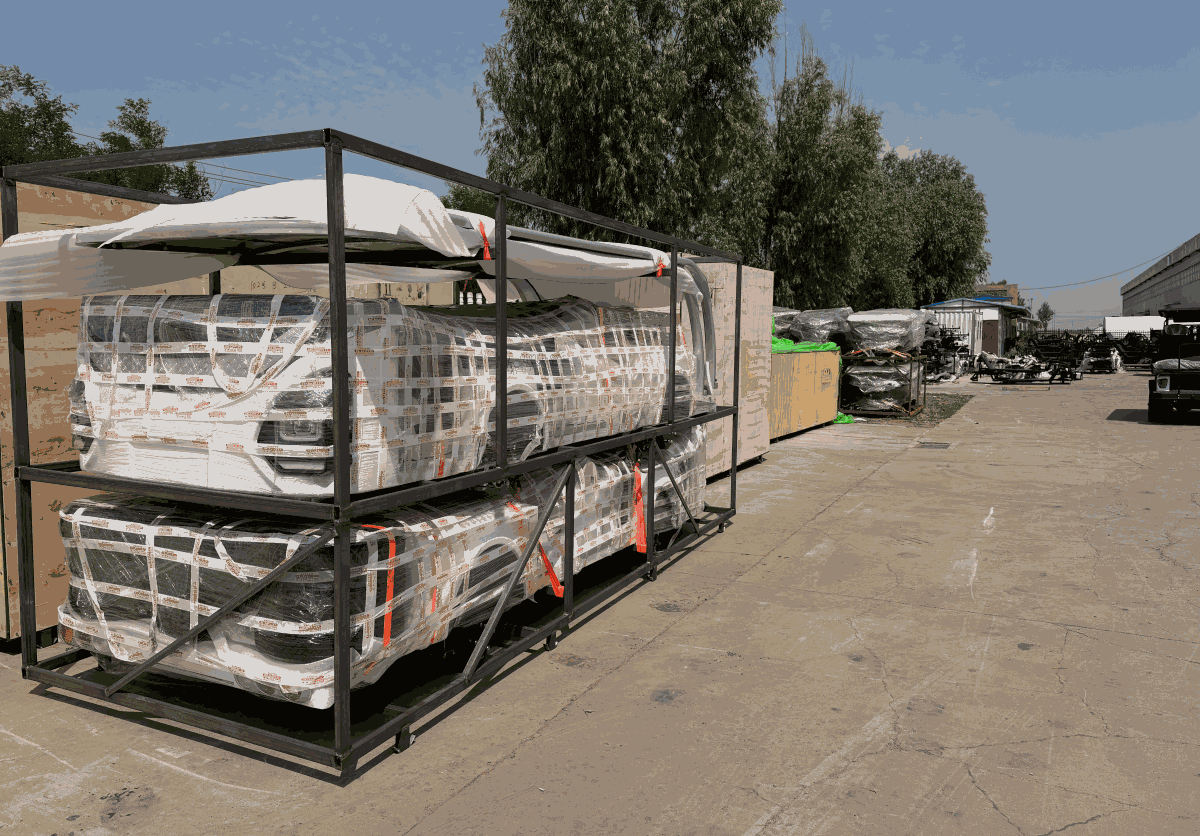
Look closely at the image above from the Keldi factory yard. On the left is our custom-engineered steel SKD matrix; on the right is a traditional wooden crate.
Wooden crates are thick, heavy, and structurally weak. They cannot be safely stacked more than two tiers high inside a moving ocean container without the risk of collapsing under their own weight. This means the trading company is forcing you to pay to ship "empty air," severely limiting your container capacity and driving your freight costs through the roof.
At Keldi, our logistics frames are born in the same R&D department as our vehicles. We don't just "pack" buggies; we engineer a cohesive transit ecosystem.
Because we own the manufacturing process, we use the exact CAD data of our chassis to weld bespoke 3D steel frames. The vehicle does not just sit in the frame—it locks into it.
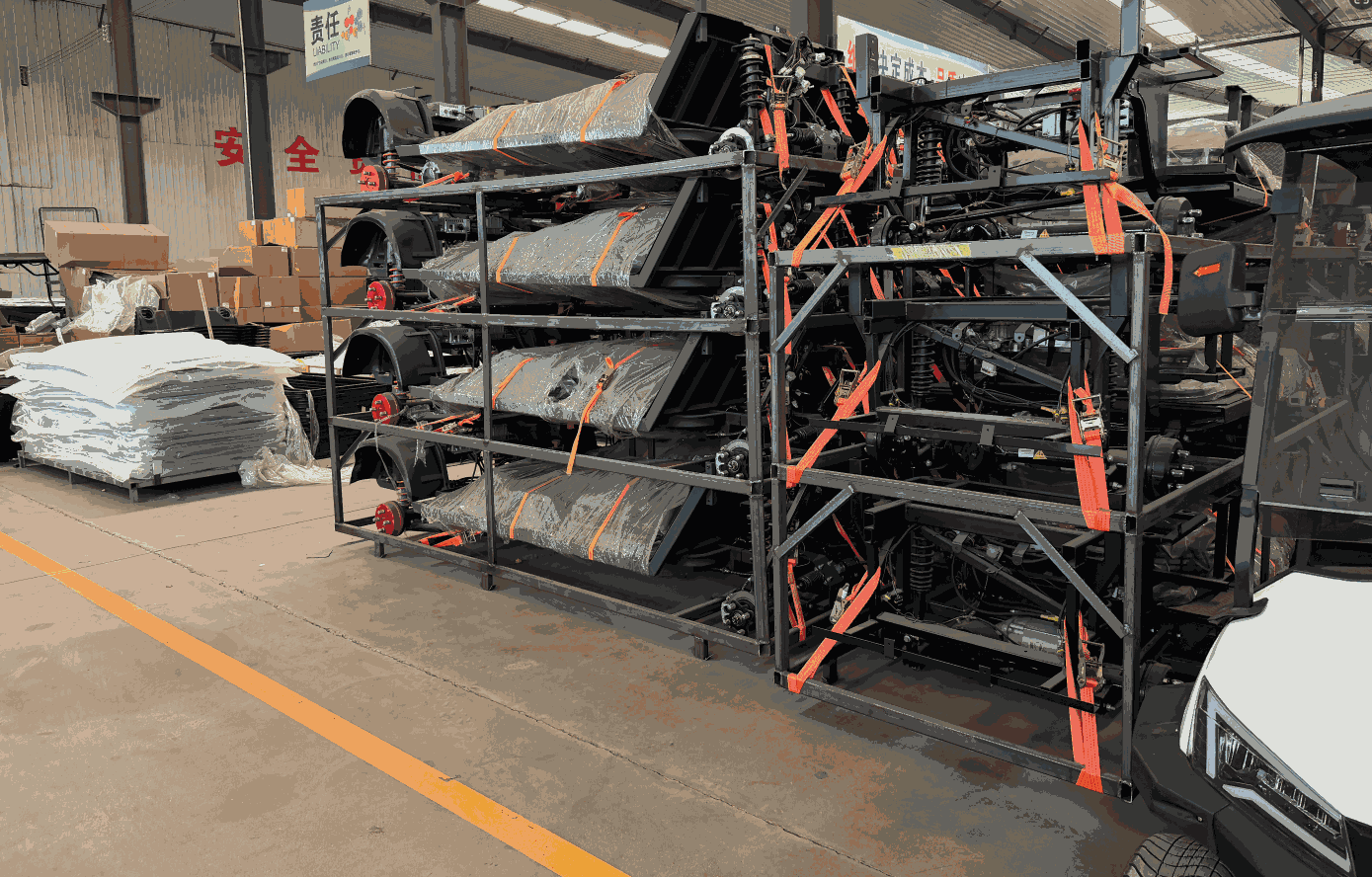
As shown in our assembly facility above, our custom frames allow for highly dense, four-tier stacking without any structural compromise. Notice the heavy-duty orange ratchet straps—these anchor points are specifically designed to align with the strongest parts of the buggy’s suspension and chassis.
A trading company cannot execute this level of precision. This photo is undeniable proof of a factory that controls its own metalworking and assembly lines.
Partnering with a supplier who lacks SKD steel frame capabilities isn't just a red flag; it is a direct financial loss.
When a middleman forces you to use wooden crates or ships fully assembled units, you are likely only fitting 10 to 18 buggies into a 40HQ container. By utilizing Keldi's custom-welded 3D steel frames, we completely eliminate the structural waste, allowing us to safely pack up to 24 units per 40HQ container.Read our Ultimate B2B Guide to Slashing Buggy Ocean Freight to see exactly how our 24-unit packing strategy saves you hundreds of dollars per vehicle.)
Q: Why do wooden crates often result in damaged buggies upon arrival?
A: Plywood absorbs moisture during ocean transit, weakening its structural integrity. If a ship encounters rough seas, stacked wooden crates often buckle and collapse, crushing the roofs and windshields of the buggies inside. Steel frames eliminate this risk entirely.
Q: If a supplier sends me photos of steel frames, how do I know they aren't just stolen images?
A: Ask them for a live video call. Tell them you want to see the steel frame welding station or the vehicles being actively strapped into the frames. A true source factory like Keldi will gladly show you the live process.
Do not let a trading company's lack of engineering capabilities destroy your profit margins with inefficient shipping and broken wooden crates.
Demand the security, density, and financial savings that only a true source manufacturer can provide. Contact Keldi today to partner with a factory that engineers your profitability from the chassis to the shipping container.
--------------------------------------------------
KELDI Golf Cart & Sightseeing Buggy | Source Manufacturer
—— Delivering High-Profit, Ultra-Stable Electric Transport Solutions Globally
Skip the middleman markups and unreliable builds. Backed by massive source-factory manufacturing, Keldi provides comprehensive fleet solutions—from heavy-duty anti-corrosion engineering and rapid delivery to lifetime spare parts supply—maximizing your ROI and ensuring seamless operations.
📧 Get Direct Factory Quotes: info@keldigolfcart.com
🌐 Explore Factory Capabilities: www.keldigolfcart.com
📞 WhatsApp / WeChat: +86 15068872777

Built to Mod, Born to Profit.
The ultimate platform for custom golf cart professionals.
Shandong Dezhou
+86 15068872777
info@keldigolfcart.com
Whatsapp:

© KELDI2026.All right reserved.Powered by KELDI
China HQ: Shandong, Dezhou
Whatsapp:+86 +86 15068872777


